Bluebell Woods: Where the Light Learns to Soften
There is a moment in the turning of the year that does not announce itself with certainty. It arrives on the edge of things, between the last lingering chill of winter and the first true warmth of spring. It is not marked on calendars in any meaningful way, nor does it demand our attention with brightness or bloom. It waits, instead, for a particular kind of noticing. And then, almost without warning, it is there.
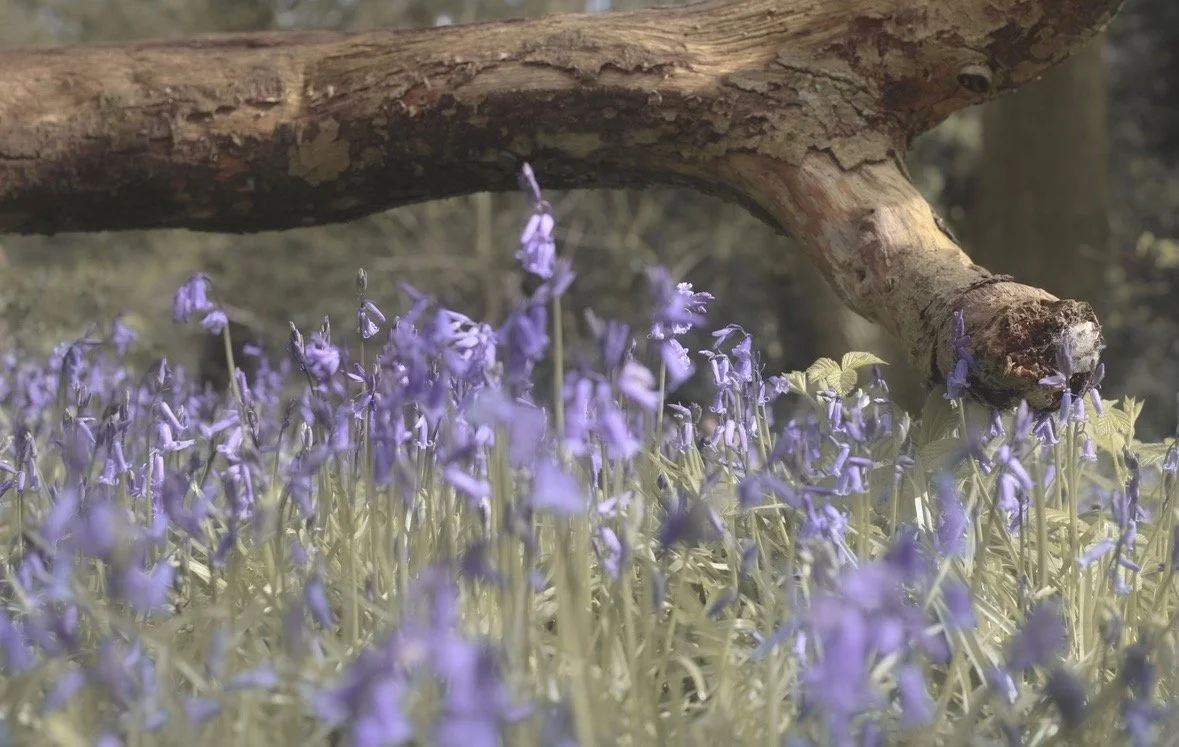
You step into the woods, perhaps expecting little more than damp earth and the slow return of green, and instead you find the ground transformed. A quiet sea of blue stretches out beneath the trees, each stem rising gently, each bell-shaped flower bowed as if in reverence to something unseen. The first bluebells of spring. Not scattered. Not tentative. But abundant. As though the earth, having held itself in stillness for so long, has finally exhaled.
You feel it before you fully register it. The moment where the open world gives way to the woodland edge. The light shifts first, softening, filtering, losing its sharpness. The air follows, cooler and richer, carrying with it the scent of soil, leaf, and something faintly sweet that feels both familiar and impossible to place. And then, as you step beneath the canopy, something in you changes.
It is subtle. But undeniable. The body, so accustomed to holding itself in readiness, begins to loosen its grip. Not all at once. Not dramatically. But in small, almost imperceptible ways. The shoulders drop a fraction. The breath deepens without instruction. The pace slows, not from effort, but from inclination. You are not walking in the same way you were moments before. The woodland has asked something of you. And without resistance, you have answered.
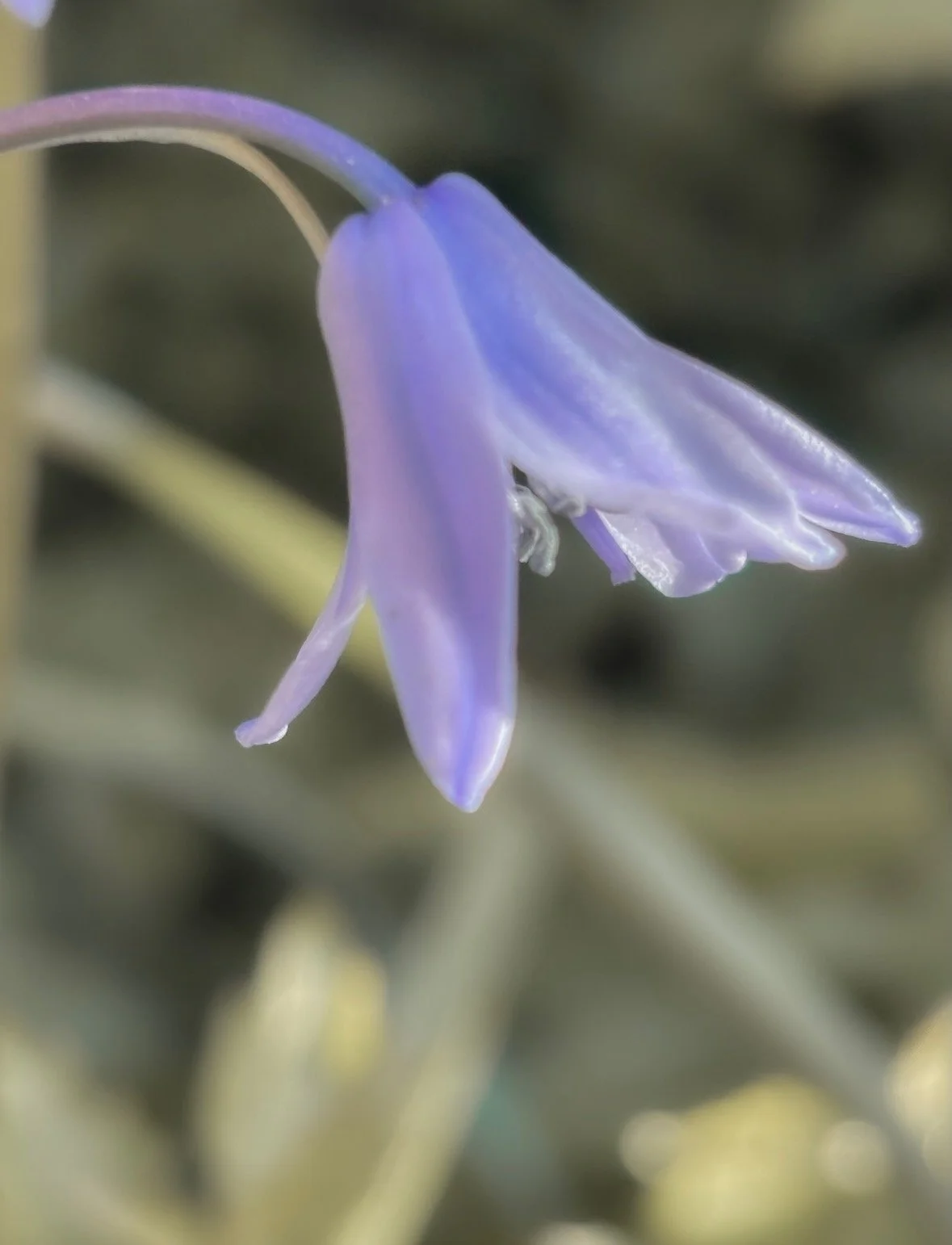
Bluebells do not behave like other flowers. They do not draw the eye through contrast or boldness. They do not stand apart from their surroundings. Instead, they gather. They move together. They create something that feels less like a collection of individual plants and more like a presence. A field of blue that hums quietly at the edge of perception. The colour itself is difficult to name precisely. It is not the clear blue of sky, nor the deep blue of water. It carries something softer. A violet undertone. A shadowed quality that seems to shift with the light, deepening in the shade, lifting into brightness where the sun touches it.
And there is something about this colour that the body responds to instinctively. Cool tones, particularly in the blue spectrum, have long been associated with calming effects on the nervous system. Not in a superficial or aesthetic way, but in a deeply physiological sense. Blue is the colour of distance, of horizon, of space. It signals openness. It tells the body that there is room to breathe, that there is no immediate threat pressing in. When we stand within a bluebell wood, surrounded on all sides by this gentle, immersive colour, we are not simply observing it. We are being influenced by it. The eyes take it in, and the brain translates it into signals that move quietly through the body: You are safe here. You can soften.
At first, you might think there is no scent at all. Bluebells are not like rose or lavender, whose presence can be detected from a distance. Their fragrance is delicate, almost elusive. It asks for stillness. It asks for attention. But if you pause, truly pause and allow yourself to remain in one place for a few moments, it begins to gather. A faint sweetness. Green, but not sharp. Soft, but not empty. There is something slightly honeyed beneath it, something that feels as though it belongs to another time. A scent that does not seek to impress, but to accompany.
And scent, perhaps more than any other sense, moves directly into the emotional and physiological centres of the brain. The olfactory pathways bypass the usual filters, connecting almost immediately to the limbic system, the place where memory, emotion, and nervous system regulation intertwine. This is why a scent can stop you. Why it can bring something back that you had not consciously remembered. Why it can soften you before you have time to understand why. The scent of bluebells does not overwhelm the system. It reassures it.
In early spring, the woodland canopy has not yet fully closed. The trees are still in the process of leafing, and so the light is allowed through in a way that will not be possible later in the season. It filters through branches and emerging leaves, breaking into patterns that shift with the slightest movement of air. Dappled light. Living light. It does not sit still. It moves across the forest floor, across the bluebells, across your skin, creating a constant, gentle variation that the eyes cannot fix upon in a rigid way. And this matters.
The human nervous system is not designed for the static, unchanging light environments we so often inhabit. Artificial lighting, screens, and enclosed spaces present the eyes with a fixed, unvarying field that encourages a kind of visual holding, a subtle tension in the system that can contribute to fatigue and overstimulation. Woodland light does the opposite. It invites the eyes to soften. To track gently. To release the need to focus in a fixed, narrow way. This, in turn, signals to the brain that it is safe to shift out of hyper-focus, out of vigilance, and into a more receptive, expansive state. The nervous system follows the eyes. And here, the eyes are allowed to rest.
We speak often of the nervous system as though it exists in isolation. As though it is something contained entirely within the body, responding only to internal processes or immediate threats. But this is not how it works. The nervous system is relational. It is constantly reading the environment, interpreting cues, adjusting its responses based on what it perceives around it. In a bluebell wood, the cues are consistent. Softness. Rhythm. Variation without chaos. Sound without intrusion. Light without harshness. These cues speak directly to the autonomic nervous system, the part of us that regulates functions we do not consciously control, heart rate, digestion, breath, and the delicate balance between activation and rest.
The sympathetic branch, the part responsible for mobilisation, for action, for readiness, begins to quiet. Not because it is suppressed. But because it is no longer needed in the same way. And as it softens, the parasympathetic branch begins to emerge.
The parasympathetic nervous system is often described as the “rest and digest” state. But this description, while accurate, does not capture its depth. It is not simply about rest. It is about restoration. In this state, the body is able to direct energy toward processes that are essential for long-term health but are often compromised under constant stress. Digestion becomes more efficient. Nutrient absorption improves. The immune system functions with greater balance. Inflammatory processes are moderated. The heart rate slows, becoming more variable and adaptable. And perhaps most importantly, the mind becomes less fragmented. Thoughts begin to settle. Attention becomes less scattered. There is space between stimulus and response. In a bluebell wood, this shift is not something we have to force. It is something we are invited into.
At the centre of this shift is the vagus nerve. A long, wandering nerve that connects the brain to the body, moving through the heart, lungs, and digestive system. It plays a key role in regulating the parasympathetic response, acting as a bridge between what we experience and how the body responds. The vagus nerve is highly responsive to sensory input. Gentle sound. Soft light. Rhythmic movement. Safe, natural environments. All of these stimulate vagal tone, the ability of the nervous system to move flexibly between states, to activate when needed and to rest when it is safe to do so.
In a bluebell wood, vagal tone is supported without effort. The sound of birdsong, irregular yet rhythmic. The visual softness of dappled light. The steady, grounding sensation of earth beneath your feet. The gentle movement of air through the trees. These are not separate experiences. They are a coordinated offering. And the body receives them as such.
Even the act of walking changes here. On a woodland path, the ground is uneven, responsive, alive. Each step requires a small adjustment, a subtle engagement of muscles and balance systems that are often underused in more controlled environments. This kind of movement is deeply regulating. It brings the body into present awareness. It engages proprioception, the sense of where the body is in space. It grounds attention in physical sensation rather than abstract thought. Walking in a bluebell wood is not just movement. It is communication. Between body and land. Between internal rhythm and external environment.
There is often a moment, unexpected, unplanned, when something in you recognises the place you are in. It may not be a conscious memory. Not something you can name or place. But a feeling. A familiarity. As though you have been here before, even if you have not. This is the body remembering. Not in the way the mind remembers, through narrative or detail, but through sensation. Through a deep, cellular recognition of what it feels like to be in a place that does not ask you to be anything other than what you are. For many of us, this kind of environment is rare. And so when we encounter it, something in us responds. Not with excitement. But with relief.
In a bluebell wood, time behaves differently. It is not measured in minutes or hours. It is felt. There is no urgency here. No expectation that you move at a particular pace or achieve a particular outcome. The usual markers of productivity and progress fall away, replaced by something quieter. Presence. You may find that you lose track of how long you have been there. Or that you no longer feel the need to know. This is not inefficiency. It is recalibration. The nervous system, so often driven by external demands, is allowed to return to its own rhythm.
Eventually, you will leave. You will step back out of the woodland and into the open, where the light is brighter, the air thinner, the sounds sharper. The world will return in its familiar form. But you will not be exactly as you were when you entered. Something will have shifted. Perhaps only slightly. Perhaps in ways that are difficult to articulate. But present nonetheless. A softness behind the eyes. A steadiness in the breath. A sense of space where there was once tension. And this is the quiet gift of the bluebell wood. Not escape. But return.
The true impact of a place like this is not confined to the time spent within it. It lingers. In the way you breathe later that day. In the way you respond to something that might previously have unsettled you. In the subtle shift toward patience, toward presence. The nervous system does not forget these experiences. It learns from them. Each time you enter a space that signals safety, that invites softness, that allows restoration, you are strengthening the pathways that make it easier to return to that state again. This is not passive. It is deeply active. A form of care that works beneath the surface, reshaping patterns that may have been held for years.
Long after you have left, the bluebells will remain. For a while. And then, as quietly as they arrived, they will fade. The canopy will close. The light will change. The woodland will shift into a different expression of itself. But the memory will stay. Not only in the mind. But in the body. A reference point. A reminder of what it feels like to be held in a state of quiet safety, of gentle presence, of unforced being. And when the world begins to feel too sharp, too fast, too much, you will know, somewhere within you, that there is a place where the light softens. Where the breath deepens. Where the nervous system remembers how to rest. And when spring returns, as it always does, so will the bluebells. Unhurried. Uncertain. Unmistakably themselves. Waiting, once again, for you to step into the woods and remember.