Held Between Hours: Dandelion, Light and the Quiet Turning
There is a moment in early spring that arrives almost unnoticed. Not marked by blossom, not announced by birdsong, but carried quietly in the dark hours of the night. At 2am, while most of us are asleep, the clocks move forward. An hour slips away, not lost, but gathered into the lengthening light. We wake, and something is different. Not enough to name. But enough to feel. The body notices first. A subtle shift at the edges of sleep. A slight heaviness in the morning, or a lightness that feels unfamiliar. A sense of being gently out of step, not wrong, not unwell, just… adjusting. There is a space here that is easy to overlook. The world moves forward in an instant. The body does not. And it is in this quiet discrepancy that something important reveals itself.
For most of our lives, we are taught to follow the clock. To rise when it tells us to rise, to work, to rest, to sleep according to its rhythm. But the body listens to something older. Light on the skin. Darkness behind the eyes. The slow, seasonal turning of the land beneath our feet. When the clocks change, we are reminded, however briefly, that these two rhythms are not always the same.
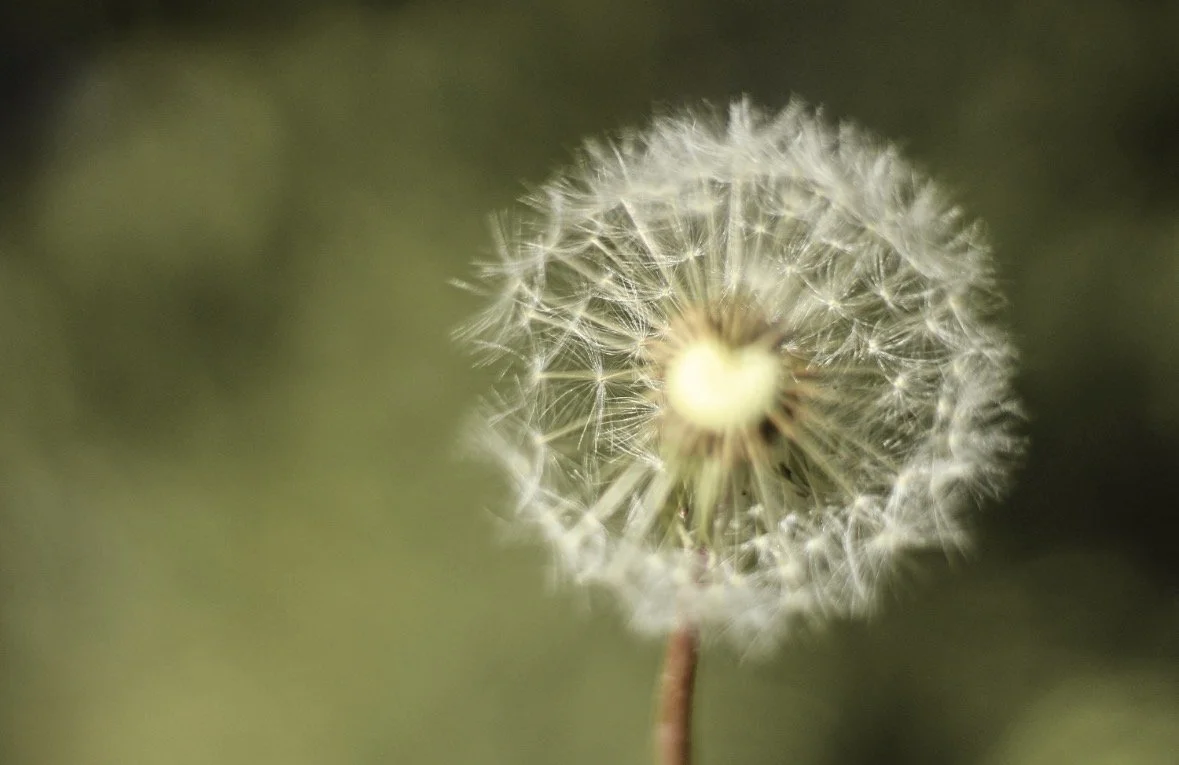
This is a threshold. Not defined by the moment of change itself, but by the space that surrounds it. The day before. The morning after. The quiet in-between where nothing quite fits yet. It is here that I find myself returning, again and again, in both my life and my practice. Because it is here that the plants speak most clearly. In the grass, the dandelions are already moving through their own becoming. Bright yellow flowers, open and sun-facing, so often taken as a sign that spring has truly arrived. And then, almost without notice, they change. The petals close. The stem elongates. And what remains is something entirely different. A dandelion clock.
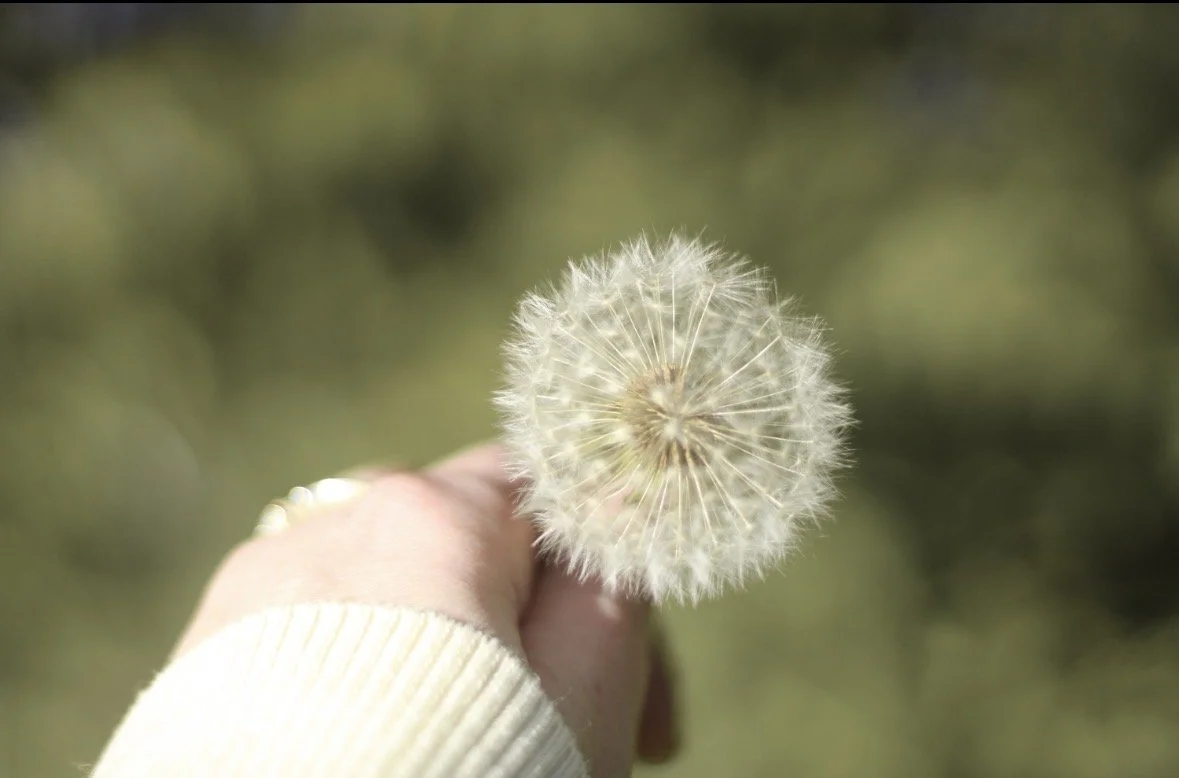
These soft, spherical seed heads have long held a place in both folklore and memory. Children are taught to blow on them, to make a wish, to watch the seeds lift and scatter into the air. There is an old tradition that suggests you can tell the time this way, counting how many breaths it takes to clear the seeds. Of course, it is not precise. But precision was never the point. It is a way of relating to time that feels almost lost now. Time, not as something counted in minutes and hours, but as something felt in the body. Time as breath. Time as release.
In some parts of Britain and Ireland, dandelions were known as “blowballs” or “clocks,” and were associated not only with telling the time, but with divination. Children would ask questions before blowing the seeds, how many years until marriage, how many wishes might come true, reading the pattern of what remained as an answer. Elsewhere, the plant carried a different kind of symbolism. To some, it was a messenger between worlds, its seeds travelling on the wind, crossing unseen boundaries. To others, it was simply a sign of persistence, appearing in places where little else would grow, thriving in compacted soil, along paths, at thresholds.
It has always been a plant that exists between states. Between root and air. Between holding and letting go. Between what is grounded and what is carried. In herbal practice, dandelion (Taraxacum officinale) is often introduced as a familiar ally. A bitter tonic. A liver support. A digestive stimulant. Its roots run deep, drawing up minerals from the soil, while its leaves and flowers offer nourishment in early spring, when other greens are scarce. But to reduce it to its actions alone is to miss something essential.
Dandelion is a plant of movement. Not sudden, forceful movement, but steady, persistent flow. Its bitterness awakens the digestive system, encouraging the release of bile, supporting the liver in its work of transformation and elimination. It moves stagnation, not by pushing aggressively, but by gently reminding the body of what it already knows how to do. There is intelligence in this. A kind of quiet insistence. Energetically, dandelion sits at a threshold. It is neither purely grounding nor purely dispersing. It holds the root firmly in the earth, while allowing the seed to travel freely. It teaches us how to be both.
This feels particularly relevant at this time of year. As the light begins to return, the body is invited into movement once again. Winter’s inward focus begins to loosen. Energy, which has been conserved, begins to rise. But this is not always a smooth process. There can be resistance here. Fatigue. Restlessness. A sense of being pulled in two directions at once. Part of us still wanting to remain in the quiet of winter. Another part beginning, tentatively, to reach outward. The change in daylight plays a significant role in this. As days lengthen, our hormonal rhythms begin to shift. Cortisol, melatonin, and other regulatory systems respond to the increasing light, gradually adjusting sleep-wake cycles and energy patterns. But this process is not immediate. The body requires time to recalibrate. And in that time, we may feel unsettled. This is where herbal energetics offers something different. Not a solution, but a way of understanding. A way of meeting the body where it is, rather than asking it to move faster than it is ready to.
Alongside dandelion, we find other plants that support this transition.
Lemon balm (Melissa officinalis)
With its light, uplifting quality, gently lifting the mood without overstimulation. It brings a sense of ease to the nervous system, particularly when there is tension held beneath the surface.
Oatstraw (Avena sativa)
Deeply nourishing and restorative, offering steady support to a system that may feel depleted after the long months of winter. It does not act quickly, but its effects are profound over time.
Chamomile (Matricaria chamomilla)
Warming, soothing, and grounding, particularly when there is digestive or emotional sensitivity. It softens the edges of change, allowing the body to settle into its new rhythm.
These are not herbs of urgency. They do not force the body forward. They accompany it. This is perhaps one of the most important lessons the plants offer us. That change does not need to be abrupt. That movement does not need to be forced. That there is wisdom in allowing things to unfold.
In older traditions, the turning of the year was marked not by a single moment, but by a series of thresholds. Imbolc, at the beginning of February, signalled the first stirring of spring, the quickening beneath the soil, the return of light, however faint. The Spring Equinox marked a point of balance, equal day and night, a moment of equilibrium before the days began to lengthen more noticeably. These were not fixed points of change, but markers along a continuum. Reminders that the seasons move gradually, even when we are not paying attention.
The changing of the clocks is a modern addition to this cycle. A human attempt to align ourselves more closely with the light. And yet, it remains somewhat at odds with the slower, more organic rhythms of the body and the land. Perhaps this is why it feels the way it does. Why there is a slight disorientation, a quiet sense of being out of step. We are being asked to move quickly, in a way that the rest of the natural world does not. The dandelion does not change in a single hour. It moves through its stages with patience. From root, to leaf, to flower, to seed. Each stage complete. Each stage necessary. And perhaps this is the invitation. Not to resist the change, but not to rush it either. To recognise that we are allowed to move through our own stages. To be, for a time, in between.
There is a quiet kind of trust required here. A willingness to remain present, even when things feel uncertain. To allow the body to find its rhythm, rather than imposing one from outside. This is not always easy. We live in a world that values speed, efficiency, immediate adaptation. But the plants remind us of another way. To move with rhythm, rather than against it. To listen. To wait. To trust. As the clocks move forward and the days begin to lengthen, we will, in time, find our place within this new rhythm. Energy will return. Sleep will adjust. The sense of disorientation will pass. But it will not happen all at once. And that is not a problem to be solved. It is a process to be lived.
The dandelion clock stands as a quiet reminder of this. Each seed held for a time, before being released. Each moment complete in itself, before giving way to the next. Time is not only what the clock tells us. It is what we feel in the body. What we observe in the land. What we release, breath by breath. And perhaps, like the dandelion, we can trust that we are already in motion. Already becoming. Even here, in the quiet space between hours.