Woodland Secrets
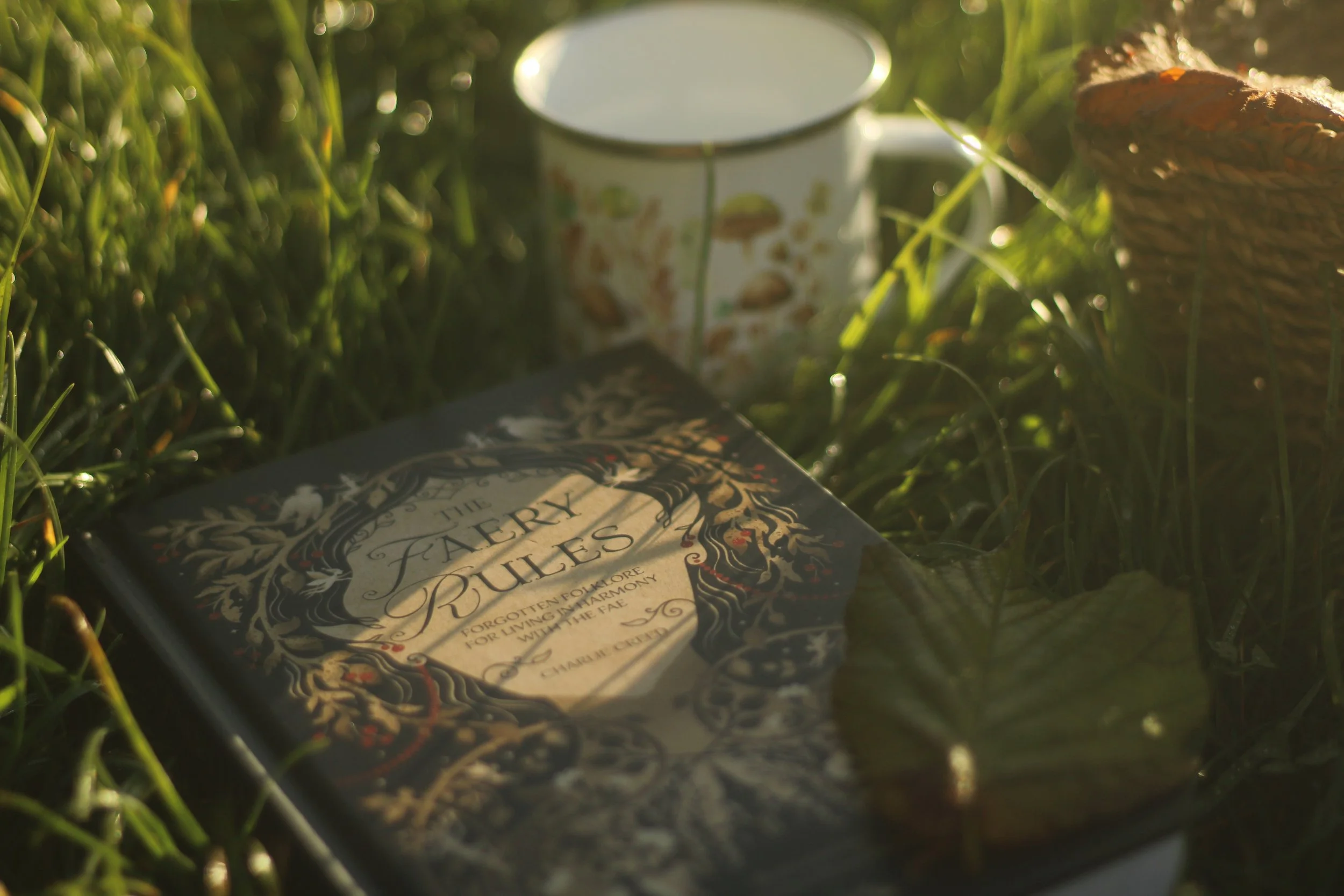
Beneath the roots of ancient trees, amongst the moss-covered stones and beyond the familiar paths of the woodland, another world was said to exist, inhabited by beings whose ways were older than memory and whose presence was felt in the quiet, forgotten corners of the landscape. These were the hidden folk, the Fae, whose stories have travelled through generations of British folklore, carried in whispered warnings, fireside tales and customs observed long after their meanings began to fade.
The Faery Rules: Forgotten Folklore for Living in Harmony with the Fae, written by Charlie Creed, published by Verbena Books and beautifully illustrated by Constance Herasimenka, gathers these old beliefs into a wonderfully atmospheric little book, inviting readers into a world where the boundary between the familiar and the unseen was once thought to be no wider than a woodland path.
On the back cover, beneath a golden crescent moon and the branches of an extraordinary tree, two warnings offer a glimpse of what lies within:
Do not speak their names lightly. Do not accept their gifts.
Such words belong to a time when encounters with the Fae were approached with caution and respect, when the smallest kindness might be rewarded and a careless word could bring misfortune.
Throughout the book, Charlie explores the customs and traditions surrounding these mysterious beings, from protecting the home and avoiding their displeasure to recognising their presence and finding a way back from Faeryland. The chapters unfold almost like instructions passed down beside a winter hearth, preserving the curious rules by which generations once believed the human and faery worlds might exist alongside one another.

Amongst the pages are some wonderfully peculiar tales. An elderly changeling reveals its true nature upon seeing a meal prepared in eggshells, declaring that although it has witnessed the world since before the first oak grew from its acorn, never has it encountered such a strange way of cooking. Elsewhere, a single blackbird is promised as a feast for fifteen reapers, while the Wild Hunt rides across the darkened skies, its spectral company led, according to different traditions, by Herne the Hunter, Gwyn ap Nudd or King Arthur.
Yet beneath these extraordinary stories lies a reminder that the faeries of older folklore were very different from the delicate, winged creatures that later found their way into children’s books. They could be beautiful and generous, but equally unpredictable, proud and dangerous. The old tales were not always intended to comfort. Many served as warnings, reflecting the fears, uncertainties and beliefs of the communities that told them. The book also acknowledges the darker history of changeling traditions, while preserving stories in which gentleness and kindness offered the hope of a more peaceful outcome.
For those drawn to the folklore of plants, one of the most fascinating chapters explores the relationship between the Fae and the green world. Here, familiar herbs and wildflowers take on another meaning, their roots, leaves and blossoms woven into the protective customs of earlier generations.
St John’s Wort, long associated with midsummer traditions, appears amongst the plants believed to offer protection against faery influence. Garlands were hung on Midsummer’s Eve, yet gathering the herb on that very night was said to carry its own dangers. Such contradictions are part of the beauty of folklore, where a plant might be both a guardian and a warning, depending upon the season, the hour and the story being told.
The turning year runs throughout these traditions, and the final chapters follow the seasonal celebrations from Whitsuntide through to Samhain. As autumn deepens and the nights draw in, the old stories gather around thresholds, hearth fires and the places where the living world was believed to meet the unseen. Food might be left outside the door, fires kindled against wandering spirits, and familiar paths approached with greater care. It is easy to imagine these tales being told on a cold October evening, when the last leaves cling to the hedgerows and darkness settles early over the fields.
Constance Herasimenka’s illustrations bring an extraordinary beauty to the book. Worked in sepia, black and gold, with touches of red amongst berries and garlands, they seem to belong to another age. Wild-haired women wear crowns of birds, faeries gather amongst oak leaves and acorns, an old spinner sits beneath a willow, and a bearded king emerges from a tangle of ancient roots. There is an intricacy to these illustrations that invites lingering. Each page reveals another small detail, another creature or curling branch, as though the pictures themselves are keeping secrets. They have the feeling of old woodcuts or forgotten illustrations discovered between the pages of a book that has rested for generations upon a dusty shelf.
The binding is equally beautiful, its gold decoration resting against a dark cover, giving the book the appearance of something treasured and handed down. Small enough to accompany a woodland walk, it feels equally at home beside a candle on a winter evening, when the wind moves through the bare branches outside and the old stories seem a little closer.
What makes The Faery Rules so appealing is the way it preserves the relationship between folklore and the natural world. The stories belong to trees, hills, streams, wildflowers and the changing seasons, to the landscapes through which generations have walked and wondered. Whether read as a collection of traditional beliefs, a companion to British folklore or an invitation to rediscover the stories hidden within familiar places, it is a book filled with curiosity, mystery and a deep appreciation for the old ways. And the next time a woodland path disappears amongst the trees, or a ring of mushrooms appears in the grass, it may be worth remembering that, according to the old tales, not every place was believed to belong entirely to the human world. Some paths were best left undisturbed. And some gifts were never meant to be accepted.